DOI: 10.12890/2025_005007
Caught in the crossfire: a case of splenic infarction amid G-CSF therapy in chronic myelomonocytic leukaemia
Authors
 supriyapeshin720@gmail.com
Keywords
Splenic infarction, G-CSF, chronic myelomonocytic leukaemiaAbstract
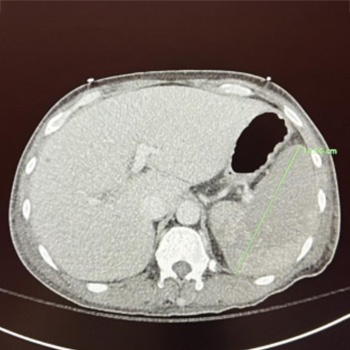
This report highlights a rare but significant complication associated with the use of granulocyte-colony stimulating factor (G-CSF) therapy, specifically splenic infarction, in a 67-year-old male with chronic myelomonocytic leukaemia (CMML) undergoing chemotherapy. G-CSFs, such as pegfilgrastim, are frequently used to prevent febrile neutropenia in cancer patients undergoing myelotoxic chemotherapy. While G-CSF is effective in reducing the risk of neutropenia, its administration has been linked to uncommon but severe complications such as splenic infarction and rupture. Our patient, receiving dose-dense chemotherapy with G-CSF support, developed severe abdominal pain midway through treatment. A computed tomography (CT) scan revealed multiple splenic hypodensities consistent with splenic infarction, but no active bleeding. Conservative management was successfully employed, avoiding surgical intervention. This case underscores the need for vigilance when administering G-CSF, particularly in patients at high risk for complications, and contributes to the limited body of literature on G-CSF-induced splenic infarction.
References
- Tigue CC, McKoy JM, Evens AM, Trifilio SM, Tallman MS, Bennett CL. Granulocyte-colony stimulating factor administration to healthy individuals and persons with chronic neutropenia or cancer: an overview of safety considerations from the Research on Adverse Drug Events and Reports project. Bone Marrow Transplant 2007;40:185–192.
- Smith TJ, Bohlke K, Lyman GH, Carson KR, Crawford J, Cross SJ, et al. American Society of Clinical Oncology. Recommendations for the use of WBC growth factors: American Society of Clinical Oncology Clinical Practice Guideline Update. J Clin Oncol 2015;33:3199–3212.
- Möbus V. Adjuvant dose-dense chemotherapy in breast cancer: standard of care in high-risk patients. Breast Care (Basel) 2016;11:8–12.
- Zhou W, Chen S, Xu F, Zeng X. Survival benefit of pure dose-dense chemotherapy in breast cancer: a meta-analysis of randomized controlled trials. World J Surg Oncol 2018;16:144.
- Reinisch M, Ataseven B, Kümmel S. Neoadjuvant dose-dense and dose-intensified chemotherapy in breast cancer – review of the literature. Breast Care (Basel) 2016;11:13–20.
- Masood N, Shaikh AJ, Memon WA, Idress R. Splenic rupture secondary to G-CSF use for chemotherapy induced neutropenia: a case report and review of literature. Cases J 2008;1:418.
- Stroncek D, Shawker T, Follmann D, Leitman SF. G-CSF-induced spleen size changes in peripheral blood progenitor cell donors. Transfusion 2003;43:609–613.
- Raut SS, Shukla SN, Talati SS, Parikh SK, Parikh BJ, Anand AS, et al. Splenic infarcts following treatment with filgrastim – an unusual complication. Int J Med Appl Sci 2015;4:190–193.
- Watring NJ, Wagner TW, Stark JJ. Spontaneous splenic rupture secondary to pegfilgrastim to prevent neutropenia in a patient with non–small-cell lung carcinoma. Am J Emerg Med 2007;25:247–248.
- Yang BB, Kido A. Pharmacokinetics and pharmacodynamics of pegfilgrastim. Clin Pharmacokinet 2011;50:295–306.
- Kosaka Y, Rai Y, Masuda N, Takano T, Saeki T, Nakamura S, et al. Phase III placebo-controlled, double-blind, randomized trial of pegfilgrastim to reduce the risk of febrile neutropenia in breast cancer patients receiving docetaxel/cyclophosphamide chemotherapy. Support Care Cancer 2015;23:1137–1143.
- Alshamrani MA, Al-Foheidi M, Abdulrahim AH. Granulocyte colony stimulating factor (G-CSF) induced splenic infarction in breast cancer patient treated with dose-dense chemotherapy regimen. Case Rep Oncol Med 2019;2019:8174986.
- Riu G, Estefanell A, Nomdedeu M, Creus N. Overdose of pegfilgrastim: case report. Int J Clin Pharm 2012;34:690–692.