DOI: 10.12890/2025_005705
Misleading detection of herpes simplex virus type 1 in a patient with paraneoplastic encephalitis
Authors
 anna.vital@usb.ch
Keywords
Anti-Hu antibodies, encephalitis, herpes simplex virus type 1, small cell lung cancerAbstract
Encephalitis is a potentially life-threatening condition with infectious or autoimmune aetiologies. Autoimmune encephalitis includes paraneoplastic variants associated with specific onconeural antibodies such as anti-Hu, frequently linked to malignancies. Herpes simplex virus type 1 (HSV-1) is the leading infectious cause in adults. Differentiating between these aetiologies can be challenging.
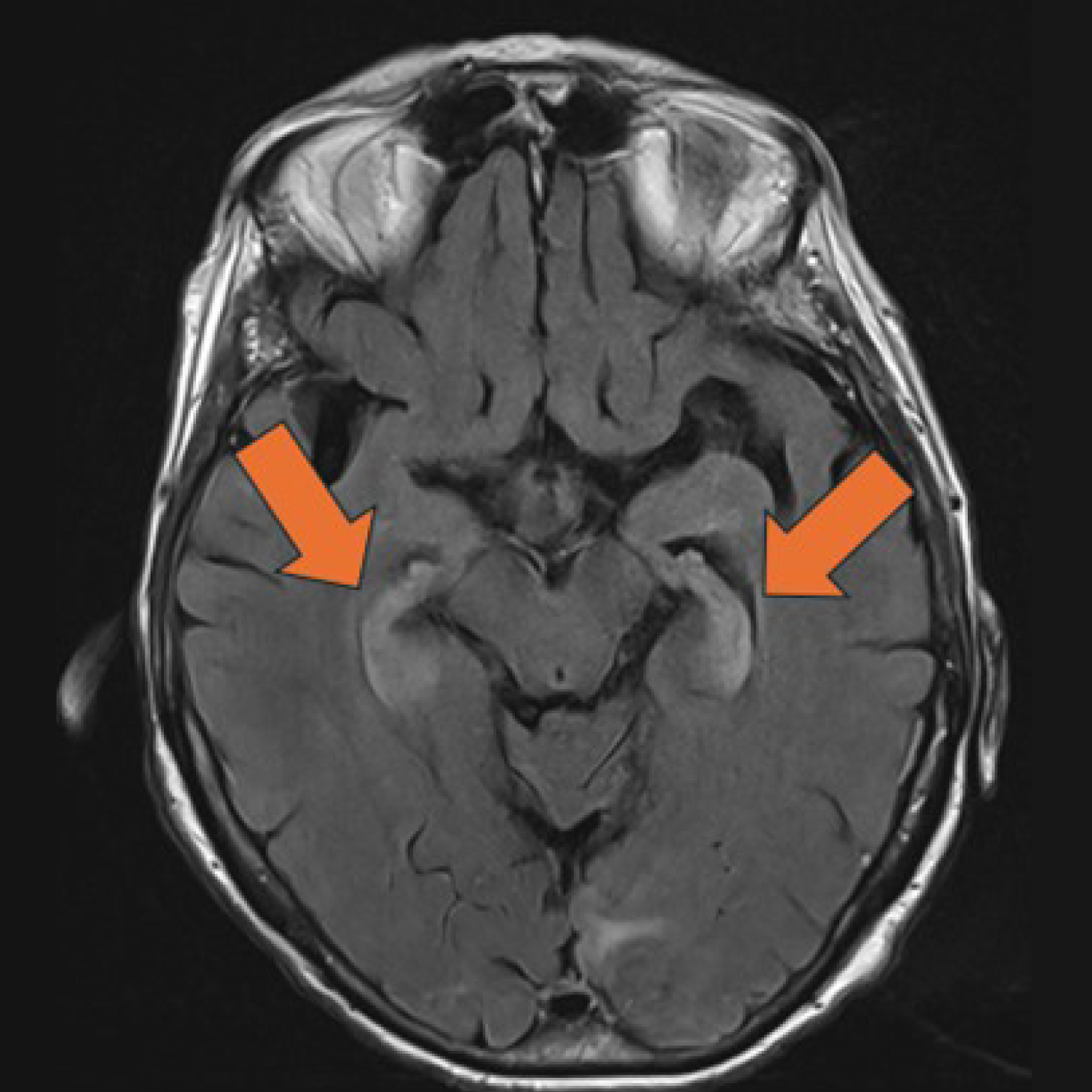
We report the case of an 88-year-old woman admitted with confusion following a fall. Initial evaluation showed clinical signs consistent with encephalitis. During hospitalisation, a seizure was witnessed. Cerebrospinal fluid (CSF) analysis revealed mild pleocytosis, but no infectious agent was detected, and brain imaging revealed no significant abnormalities. After initial improvement under antiepileptic therapy, the patient experienced worsening cognitive dysfunction. Repeat CSF testing 4 weeks after initial symptom onset showed even milder pleocytosis but was positive for HSV-1 and magnetic resonance imaging showed bilateral hippocampal hyperintensities. Analysis of the first CSF sample retrospectively revealed high-titer anti-Hu antibodies. Positron emission tomography-computed tomography scan identified a hypermetabolic lung lesion and para-aortic lymph node, with biopsy confirming the diagnosis of small cell lung cancer. Immunosuppressive and oncologic treatment led to transient improvement, followed by progressive neurological deterioration. Supportive care was ultimately prioritized. This case underscores the diagnostic challenges of encephalitis, especially when autoimmune and infectious features overlap, and diagnostic findings are misleading. Detection of HSV-1 should not delay the investigation of alternative causes of encephalitis in the absence of typical HSV-related features. Early recognition of paraneoplastic encephalitis is critical, as neurologic symptoms may precede the diagnosis of underlying malignancy.
References
- Alam AM, Easton A, Nicholson TR, Irani SR, Davies NWS, Solomon T, et al. Encephalitis: diagnosis, management and recent advances in the field of encephalitides. Postgrad Med J 2023;99:815–825. https://doi.org/10.1136/postgradmedj-2022-141812
- Benyahia B, Liblau R, Merle-Béral H, Tourani JM, Dalmau J, Delattre JY. Cell-mediated autoimmunity in paraneoplastic neurological syndromes with anti-Hu antibodies. Ann Neurol 1999;45:162-167. doi: 10.1002/1531-8249(199902)45:2<162::aid-ana5>3.0.co;2-r
- Graus F, Keime-Guibert F, Reñe R, Benyahia B, Ribalta T, Ascaso C, et al. Anti-Hu-associated paraneoplastic encephalomyelitis: analysis of 200 patients. Brain 2001;124:1138–1148. https://doi.org/10.1093/brain/124.6.1138
- Dalmau J, Furneaux HM, Cordon-Cardo C, Posner JB. The expression of the Hu (paraneoplastic encephalomyelitis/sensory neuronopathy) antigen in human normal and tumor tissues. Am J Pathol 1992;141:881-886.
- Duerlund LS, Nielsen H, Bodilsen J. Current epidemiology of infectious encephalitis: a narrative review. Clin Microbiol Infect 2025;31:515–521. https://doi.org/10.1016/j.cmi.2024.12.025
- Tyler KL. Acute viral encephalitis. N Engl J Med 2018;379:557–566. https://doi.org/10.1056/NEJMra1708714
- de Montmollin E, Dupuis C, Jaquet P, Sarton B, Sazio C, Susset V, et al. Herpes Simplex Virus Encephalitis With Initial Negative Polymerase Chain Reaction in the Cerebrospinal Fluid: Prevalence, Associated Factors, and Clinical Impact. Crit Care Med 2022;50:e643-e648. doi: 10.1097/CCM.0000000000005485
- Alessandro L, Wilken M, Farez MF, Arias Cebollada E, Mora AC, Cammarota Á, et al. Clinical correlations of positive herpes simplex PCR in cerebrospinal fluid. Neurologist 2018;23:204–208. https://doi.org/10.1097/NRL.0000000000000215
- López N, Cuesta G, Rodríguez-Vega S, Rosas E, Chumbita M, Casals-Pascual C, et al. Multiplex real-time PCR FilmArray performance in the diagnosis of meningoencephalitis: lights and shadows. Infection 2024;52:165–172. https://doi.org/10.1007/s15010-023-02076-x
- Moser T, Gruber J, Mylonaki E, Böhm V, Schwarzenhofer D, Tröscher AR, et al. Autoimmune and infectious encephalitis: development of a discriminative tool for early diagnosis and initiation of therapy. J Neurol 2024;271:7583–7591. https://doi.org/10.1007/s00415-024-12712-7
- Li J, Lin W. Various clinical features of patients with anti-Hu associated paraneoplastic neurological syndromes: An observational study. Medicine (Baltimore) 2018;97:e0649. doi: 10.1097/MD.0000000000010649
- Lawn ND, Westmoreland BF, Kiely MJ, Lennon VA, Vernino S. Clinical, magnetic resonance imaging, and electroencephalographic findings in paraneoplastic limbic encephalitis. Mayo Clin Proc 2003;78:1363-1368. doi: 10.4065/78.11.1363
- Oyanguren B, Sánchez V, González FJ, de Felipe A, Esteban L, López-Sendón JL, Garcia-Barragán N, Martínez-San Millán J, Masjuán J, Corral I. Limbic encephalitis: a clinical-radiological comparison between herpetic and autoimmune etiologies. Eur J Neurol 2013;20:1566-1570. doi: 10.1111/ene.12249