DOI: 10.12890/2025_005853
Palbociclib-induced apoptotic colopathy: a case report and review of the literature
Authors
 fdiaz@alexanderfleming.org
Keywords
Palbociclib, cyclin-dependent kinase inhibitors, drug-induced colitis, apoptotic colopathy, breast cancerAbstract
Background: Cyclin-dependent kinase (CDK) 4/6 inhibitors (ribociclib, abemaciclib, and palbociclib) are standard first-line therapy for hormone receptor (HR)-positive, human epidermal growth factor receptor 2 (HER2)-negative metastatic breast cancer. While diarrhoea is a known adverse effect, severe gastrointestinal toxicity, particularly colitis, is rare and its histopathologic features are not well-characterized.
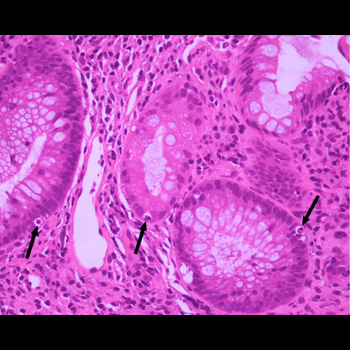
Case report: We report the case of a 65-year-old woman with HR-positive, HER2-negative metastatic breast cancer who developed severe diarrhoea and significant weight loss during palbociclib treatment. Her prior treatment included adjuvant chemotherapy, radiotherapy, and letrozole, followed by first-line treatment for metastatic disease with fulvestrant and abemaciclib. Due to recurrent grade II diarrhoea on abemaciclib, she was switched to palbociclib. One year after initiating palbociclib, she presented with 6–10 daily bowel movements, 11 kg weight loss, anaemia, and hypoalbuminemia. Infectious aetiologies were excluded. Imaging revealed pancolitis, and a colonoscopy showed multiple deep ulcers. A rectal biopsy demonstrated chronic proctitis with increased epithelial apoptosis. Palbociclib was discontinued, and oral budesonide was initiated, which led to clinical and endoscopic remission. She remained asymptomatic on fulvestrant monotherapy for over 6 months.
Conclusion: This rare case describes palbociclib-induced colitis with characteristic histopathologic findings of increased epithelial apoptosis, consistent with drug-induced apoptotic colopathy. To our knowledge, this is the first report of palbociclib-associated colitis with histological confirmation of apoptotic changes and successful treatment with budesonide. Clinicians should consider CDK4/6 inhibitors as a potential cause of severe gastrointestinal symptoms and recommend biopsy when the diagnosis is uncertain.
References
- Onesti CE, Jerusalem G. CDK4/6 inhibitors in breast cancer: differences in toxicity profiles and impact on agent choice. A systematic review and meta-analysis. Expert Rev Anticancer Ther 2021;21:283-298. doi: 10.1080/14737140.2021.1852934
- Malik AA, Abbas H, Oo ZM, Lim Z. CDK4/6 inhibitor-induced colitis: a case report and review of the literature. BMJ Case Rep 2021;14:e242766. doi: 10.1136/bcr-2021-242766
- Gomez C, Bierman T, Clarkston W. Ileocolitis associated with the checkpoint inhibitor palbociclib [abstract S3419]. Am J Gastroenterol. 2022; 117(10S):e2158. doi: 10.14309/01.ajg.0000870316.80825.04
- van Aken ESM, Beeker A, Houtenbos I, Pos FJ, Linn SC, Elkhuizen PHM, et al. Unexpected toxicity of CDK4/6 inhibitor palbociclib and radiotherapy. Cancer Rep (Hoboken) 2022;5:e1470. doi: 10.1002/cnr2.1470
- Thibault S, Hu W, Hirakawa B, Kalabat D, Franks T, Sung T, et al. Intestinal toxicity in rats following administration of CDK4/6 inhibitors is independent of primary pharmacology. Mol Cancer Ther 2019;18:257-266. doi: 10.1158/1535-7163.MCT-18-0734
- Karamchandani DM, Chetty R. Apoptotic colopathy: a pragmatic approach to diagnosis. J Clin Pathol 2018;71:1033-1040. doi: 10.1136/jclinpath-2018-205388
- Hamdeh S, Micic D, Hanauer S. Drug-induced colitis. Clin Gastroenterol Hepatol 2021;19:1759-1779. doi: 10.1016/j.cgh.2020.04.069
- Villanacci V, Reggiani-Bonetti L, Leoncini G, Parente P, Cadei M, Albarello L, et al. Histopathology of non-IBD colitis. A practical approach from the Italian Group for the Study of the Gastrointestinal Tract (GIPAD). Pathologica 2021;113:54-65. doi: 10.32074/1591-951X-234
- Marginean EC. The ever-changing landscape of drug-induced Injury of the lower gastrointestinal tract. Arch Pathol Lab Med 2016;140:748-758. doi: 10.5858/arpa.2015-0451-RA
- Miehlke S, Guagnozzi D, Zabana Y, Tontini GE, Kanstrup Fiehn AM, Wildt S, et al. European guidelines on microscopic colitis: United European Gastroenterology and European Microscopic Colitis Group statements and recommendations. United European Gastroenterol J 2021;9:13–37. doi: 10.1177/2050640620951905