DOI: 10.12890/2025_006042
Autosomal dominant osteopetrosis – identification of a new mutation
Authors
 isabelmdcmonteiro@gmail.com
Keywords
Osteopetrosis, CLCN7 mutation, autosomal dominant osteopetrosis, bone-within-boneAbstract
Background: Osteopetrosis comprises a group of rare skeletal dysplasias characterized by increased bone density and paradoxical bone fragility. Among its forms, autosomal dominant osteopetrosis (ADO) is most frequently associated with mutations in the CLCN7 gene, encoding a chloride antiporter essential for osteoclast function. CLCN7-related ADO results from impaired osteoclast acidification and decreased bone resorption. Although bone mineral accumulation is characteristic, skeletal fragility and complications such as osteomyelitis and cranial nerve compression may occur.
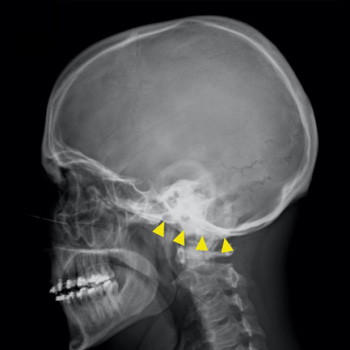
Case report: We report three related individuals who exhibited increased bone density and pathognomonic radiographic appearances of “bone-within-bone” and “sandwich-vertebrae”. Genetic testing identified a novel heterozygous CLCN7 mutation, confirming the diagnosis of ADO. This family’s novel mutation expands the known genotypic spectrum of ADO and underscores the value of genetic testing in adult-onset bone dysplasias with atypical presentation.
Conclusion: This case report highlights the diagnostic importance of recognizing characteristic radiographic patterns and confirming them through molecular analysis, emphasizing the need for multidisciplinary follow-up and appropriate genetic counselling.
References
- Sobacchi C, Villa A, Schulz A, Kornak U. CLCN7-Related Osteopetrosis. 2007 Feb 12 [updated 2022 Jan 20]. In: Adam MP, Bick S, Mirzaa GM, Pagon RA, Wallace SE, Amemiya A, editors. GeneReviews®. Seattle (WA): University of Washington, Seattle; 1993–2025.
- Jentsch TJ, Friedrich T, Schriever A, Yamada H. The CLC chloride channel family. Pflugers Arch 1999;437:783-795. doi: 10.1007/s004240050847
- Kornak U, Kasper D, Bösl MR, Kaiser E, Schweizer M, Schulz A, et al. Loss of the ClC-7 chloride channel leads to osteopetrosis in mice and man. Cell 2001;104:205-215. doi: 10.1016/s0092-8674(01)00206-9
- Funck-Brentano T, Zillikens MC, Clunie G, Siggelkow H, Appelman-Dijkstra NM, Cohen-Solal M. Osteopetrosis and related osteoclast disorders in adults: A review and knowledge gaps On behalf of the European calcified tissue society and ERN BOND. Eur J Med Genet 2024;69:104936. doi: 10.1016/j.ejmg.2024.104936
- Bénichou OD, Laredo JD, de Vernejoul MC. Type II autosomal dominant osteopetrosis (Albers-Schönberg disease): clinical and radiological manifestations in 42 patients. Bone 2000;26:87-93. doi: 10.1016/s8756-3282(99)00244-6
- Faden MA, Krakow D, Ezgu F, Rimoin DL, Lachman RS. The Erlenmeyer flask bone deformity in the skeletal dysplasias. Am J Med Genet A 2009;149A:1334-1345. doi: 10.1002/ajmg.a.32253
- Waguespack SG, Hui SL, Dimeglio LA, Econs MJ. Autosomal dominant osteopetrosis: clinical severity and natural history of 94 subjects with a chloride channel 7 gene mutation. J Clin Endocrinol Metab 2007;92:771-778. doi: 10.1210/jc.2006-1986
- Campos-Xavier AB, Casanova JL, Doumaz Y, Feingold J, Munnich A, Cormier-Daire V. Intrafamilial phenotypic variability of osteopetrosis due to chloride channel 7 (CLCN7) mutations. Am J Med Genet A 2005;133A:216-218. doi: 10.1002/ajmg.a.30490
- Polgreen LE, Imel EA, Econs MJ. Autosomal dominant osteopetrosis. Bone 2023;170:116723. doi: 10.1016/j.bone.2023.116723
- Cohen-Solal M, Collet C, Bizot P, Pavis C, Funck-Brentano T. Osteopetrosis: The patient point of view and medical challenges. Bone 2023;167:116635. doi: 10.1016/j.bone.2022.116635