DOI: 10.12890/2026_006464
Pneumoperitoneum following perineal air insufflation can be managed conservatively
Authors
 aymanco65@yahoo.com
Keywords
Pneumoperitoneum, trauma, subcutaneous emphysema, air insufflation, perineal injuryAbstract
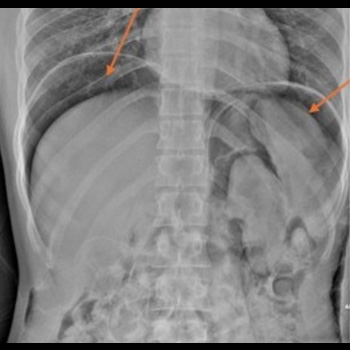
Introduction: Pneumoperitoneum is commonly associated with a perforated hollow viscus and often prompts emergency surgical intervention. However, not all cases necessitate operative management. A rare but important cause of pneumoperitoneum is air insufflation through the perianal route, which can lead to extensive subcutaneous emphysema and intra-abdominal free air without evidence of visceral perforation.
Case description: We present a case of pneumoperitoneum following perianal air insufflation managed conservatively after a thorough clinical and radiological assessment revealed no indication for surgery.
Conclusion: This case underscores the importance of distinguishing non-surgical from surgical pneumoperitoneum. Early recognition and appropriate conservative treatment can prevent unnecessary operative interventions and their associated risks.
References
- Corsi AJ, Soukat Ali A, Kumar D. Self-inflicted abdominal air insufflation leading to diffuse subcutaneous emphysema, pneumoperitoneum, pneumomediastinum, pneumopericardium, and pneumothorax: a case report. Cureus 2022;14:e30278. doi: 10.7759/cureus.30278
- Bakka HSA, Babu PK, Kutikuppala LVS, Suvvari TK, Koirala SB. A case of tension pneumoperitoneum with fecal peritonitis due to high-pressure air insufflation through the anus. Clin Case Rep 2023;11:e7344. doi: 10.1002/ccr3.7344
- Sidiqi MM, Fletcher D, Billah T. The enigma of asymptomatic idiopathic pneumoperitoneum: a dangerous trap for general surgeons. Int J Surg Case Rep 2020;76:33–36. doi: 10.1016/j.ijscr.2020.09.149
- Alassaf M. Recurring spontaneous aseptic pneumoperitoneum presenting secondary to an unrelated chief complaint: a case report. Int J Surg Case Rep 2015;7C:96–98. doi: 10.1016/j.ijscr.2014.10.038
- Estridge P, Akoh JA. Recurrent spontaneous pneumoperitoneum: a surgical dilemma. Int J Surg Case Rep 2017;30:103–105. doi: 10.1016/j.ijscr.2016.11.053
- Shamim AA, Zeineddin S, Zeineddin A, Olufajo OA, Mathelier GO, Cornwell Iii EE, et al. Are we doing too many non-therapeutic laparotomies in trauma? An analysis of the National Trauma Data Bank. Surg Endosc 2020;34:4072–4078. doi: 10.1007/s00464-019-07169-z
- Hainaux B, Agneessens E, Bertinotti R, De Maertelaer V, Rubesova E, Capelluto E, et al. Accuracy of MDCT in predicting site of gastrointestinal tract perforation. AJR Am J Roentgenol 2006;187:1179–1183. doi: 10.2214/AJR.05.1179
- Smyth L, Bendinelli C, Lee N, Reeds MG, Loh EJ, Amico F, et al. WSES guidelines on blunt and penetrating bowel injury: diagnosis, investigations, and treatment. World J Emerg Surg 2022;17:13. doi: 10.1186/s13017-022-00418-y