DOI: 10.12890/2026_007278
Endoscopic drainage of an intra-abdominal chylous collection
Authors
 hirannya.karunadasa@monash.edu
Keywords
Chylous leak, chylous ascites, endoscopic ultrasound, pancreatectomyAbstract
Introduction: Chylous leak is an increasingly recognised complication following pancreatic surgery. It results from the disruption of the lymphatic system and may lead to persistent chylous ascites or collection. Ongoing chyle loss is associated with significant morbidity including malnutrition, dehydration, electrolyte disturbance, hypoalbuminaemia, immunosuppression and impaired wound healing. Clinicians managing patients in the perioperative setting should remain vigilant for the development of chylous leak, particularly following high-risk surgery. While most cases respond to conservative management with dietary modification and use of somatostatin analogues, refractory cases remain challenging and may require technically demanding or morbid interventions. We report a novel minimally invasive approach using endoscopic ultrasound-guided cyst gastrostomy for a post-operative chylous collection.
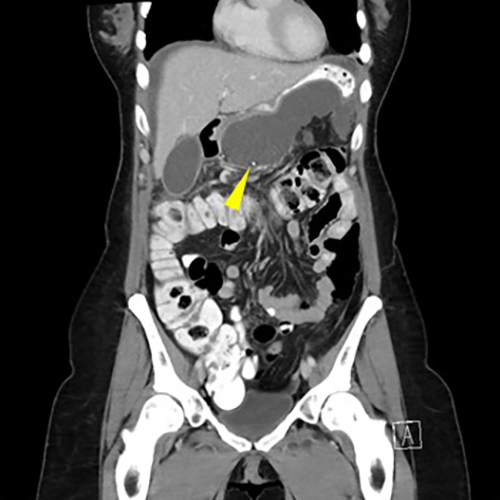
Case description: A 53-year-old woman underwent distal pancreatectomy, splenectomy and lymph node clearance for pancreatic ductal adenocarcinoma with associated extensive lymphadenopathy. On post-operative day seven, she developed abdominal pain and elevated inflammatory markers. Computed tomography demonstrated a 14 × 5 cm thin-walled collection within the lesser sac. Percutaneous drainage yielded turbid milky fluid consistent with chyle. Despite initial conservative management, a persistent high output chyle leak developed. EUS-guided cyst gastrostomy was performed, allowing internal drainage of chyle into the stomach. The patient recovered without complications, resumed oral intake and was discharged two days following the procedure.
Conclusion: EUS-guided cyst gastrostomy may represent a safe, minimally invasive therapeutic option for selected patients with persistent chylous collections. This approach may mitigate risks associated with prolonged or repeated external drainage and facilitate earlier discharge, allowing ongoing outpatient conservative management.
References
- Besselink MG, van Rijssen LB, Bassi C, Dervenis C, Montorsi M, Adham M, et al. Definition and classification of chyle leak after pancreatic operation: a consensus statement by the International Study Group on Pancreatic Surgery. Surgery. 2017;161:365–372. doi: 10.1016/j.surg.2016.06.058.
- Rebelo A, Rauchbach E, Kleeff J, Klose J. Postoperative chyle leak after pancreatic surgery: scoping review. BJS Open. 2025;10(1):zraf146. doi: 10.1093/bjsopen/zraf146.
- Weniger M, D’Haese JG, Angele MK, Kleespies A, Werner J, Hartwig W. Treatment options for chylous ascites after major abdominal surgery: a systematic review. Am J Surg. 2016;211:206–213. doi: 10.1016/j.amjsurg.2015.04.012.
- Muzzolini M, Araujo RLC, Kingham TP, Peschaud F, Paye F, Lupinacci RM. Incidence and risk factors for chyle leak after pancreatic surgery for cancer: a comprehensive systematic review. Eur J Surg Oncol. 2022;48:707–717. doi: 10.1016/j.ejso.2021.11.136.
- Chen K, Thng J, Ho D, Lawrentschuk N. Clinical practice guide: management of chylous ascites after retroperitoneal lymph node dissection. Eur Urol Focus. 2024;10:367–369. doi: 10.1016/j.euf.2024.05.005.
- Rose KM, Huelster HL, Roberts EC, Manley BJ, Gilbert SM, Sexton WJ. Contemporary management of chylous ascites after retroperitoneal surgery: development of an evidence-based treatment algorithm. J Urol. 2022;208:53–61. doi: 10.1097/JU.0000000000002494.
- Mansour NM, Salyers WJ Jr. Recurrence of a pancreatic cystic lymphangioma after diagnosis and complete drainage by endoscopic ultrasound with fine-needle aspiration. JOP. 2013;14:280–282. doi: 10.6092/1590-8577/1347.
- Staessens M. Pancreatic cystic lymphangioma in an adult: a rare clinical entity. Acta Gastroenterol Belg 2025;88:68–71. doi: 10.51821/88.1.13325
- Vanella G, Frigo F, Leone R, Rossi G, Zaccari P, Stasio RC, et al. EUS-guided drainage of post-surgical versus post-pancreatitis collections (the RESPELL study): a prospective comparison of clinical presentations and therapeutic outcomes. Dig Liver Dis. 2026;58:493–502. doi: 10.1016/j.dld.2026.01.010.